Woven vs Non Woven: Differences, Examples, and How to Choose the Right One for Your Business
In the textile industry, material selection is not just about price or appearance. Many businesses still misunderstand woven and non woven products, even though the differences between the two directly impact durability, functionality, and production efficiency. A small mistake at the beginning can lead to customer complaints, rising production costs, or even product failure in the market.
So, what exactly is the difference between woven and non woven?
Woven and Non Woven Products: What Sets Them Apart?
What is Woven?
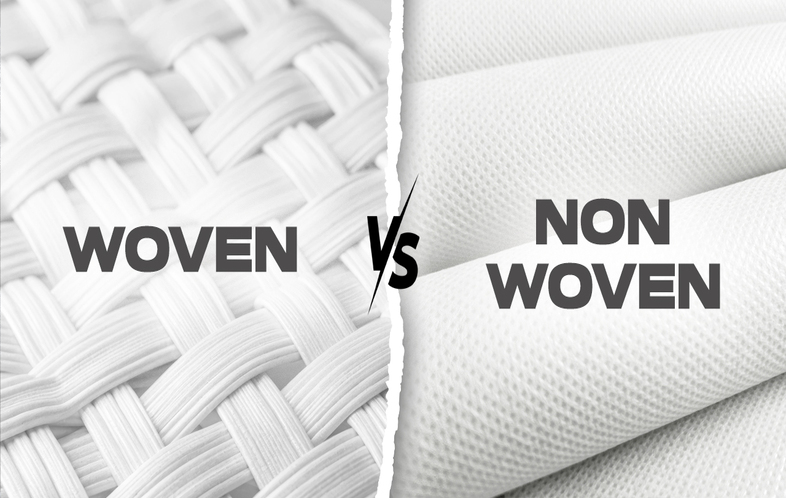
Woven fabrics are produced through a weaving process, where yarns interlace horizontally and vertically. This creates a material with a stable and strong structure.
Why woven is often chosen:
- High durability for repeated use
- Maintains shape over time
- Delivers a more solid and premium feel
Because of these characteristics, woven materials are widely used in products that require long-term performance—such as garments, uniforms, and upholstery.
What is Non Woven?
Unlike woven fabrics, non woven materials are not made through weaving. Instead, they are formed by bonding or pressing fibers together.
The result:
- Faster production process
- Lightweight and flexible
- Can be engineered for specific functions (filtration, medical use, etc.)
This is why non woven materials are commonly found in products like face masks, geotextiles, and various disposable industrial applications.
It’s Not About Which is Better—It’s About What Fits the Purpose
The most common mistake is not choosing a “bad” material, but choosing one that doesn’t match the intended function.
Common examples:
- Using non woven for products that require long-term strength → leads to faster wear and tear
- Using woven for disposable applications → results in unnecessary costs
- Assuming “thicker” means “stronger,” when structure actually matters more
In practice, material selection usually starts with a simple question:
How will the product be used, and for how long?
A Less Discussed Insight: Most Products Are Not Purely One or the Other
Interestingly, many products in the market are not purely woven or non woven.
Some combine both to achieve better balance:
- Woven structure for strength
- Non woven layers for specific functions (filtering, protection, etc.)
This hybrid approach is often used to maintain quality without significantly increasing costs.
In addition, quality standards are becoming increasingly important. For certain applications—especially in medical and industrial sectors—non woven materials often follow guidelines from ISO (International Organization for Standardization) to ensure performance and safety.
A Smarter Way to Choose the Right Material
Instead of focusing on price or appearance alone, a more effective approach includes:
- Start from the product’s end-use, not the material
- Determine whether the product is reusable or disposable
- Consider usage conditions (load, friction, environment)
- Test samples before moving into mass production
While simple, this approach often makes the difference between a product that performs well and one that struggles in the market.
Understanding the difference between woven and non woven products is not just technical knowledge—it’s part of a broader production strategy.
The right material choice can:
- Reduce costs without compromising quality
- Minimize the risk of customer complaints
- Extend product lifespan
On the other hand, the wrong decision often only becomes apparent after the product is already in circulation.
If you are evaluating the best material for your production needs—whether woven, non woven, or a combination of both—the team at Danar Mas Group is ready to help you find the most suitable solution.
Contact us today to discuss your requirements and discover materials that truly align with your business needs.