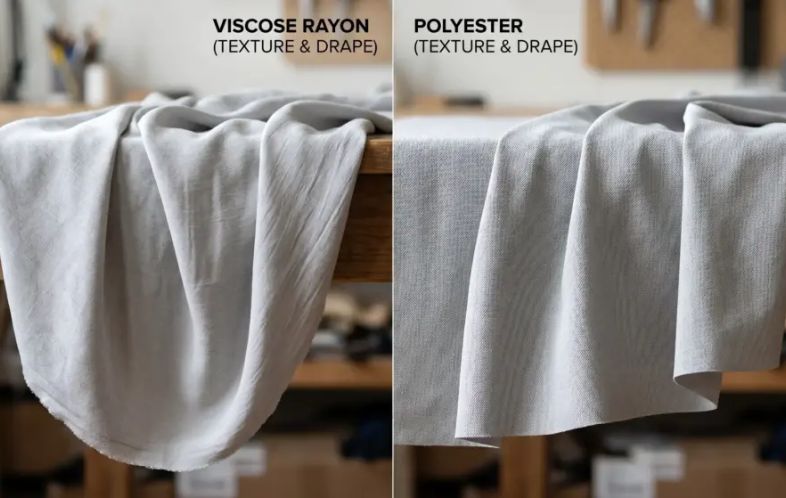
Polyester vs Viscose: Understanding the Differences Between Two Widely Used Fibers
When choosing textile materials, the fiber type is a key factor in determining the final character of a product. Polyester and viscose are both widely used, but they offer distinct characteristics. The differences go beyond simply being synthetic vs. cellulosic—they extend to strength, absorbency, comfort, and fabric appearance.
Therefore, understanding the differences between polyester and viscose will help you determine the material that best suits your product requirements.
Getting to Know Polyester and Viscose
Polyester (Strong & Durable)
Polyester is a synthetic fiber known for its excellent strength and durability. This fiber is also relatively wrinkle-resistant, easy to care for, maintains good dimensional stability, and tends to dry quickly due to its low water absorption.
Image source: Printful
These characteristics make polyester popular across various products, including sportswear, uniforms, workwear, outerwear, and home textiles. Polyester can also be produced with diverse specifications through variations in fiber type, yarn, fabric construction, and finishing processes.
Viscose (Soft & Comfortable)
Viscose is a regenerated cellulosic fiber belonging to the man-made cellulosic fibers (MMCF) group. It is renowned for its soft touch, high moisture absorption, and excellent drape.
These traits make viscose a common choice for fashion wear such as blouses, dresses, shirts, and various garments that prioritize comfort and a flowy silhouette.
So, What Are the Differences Between Polyester & Viscose?
Strength and Durability
Polyester generally excels in strength, durability, and dimensional stability, making it ideal for products that require resilience against repeated use and wear.
Viscose delivers good performance across many textile applications but is better recognized for its softness and comfort. The final quality of the fabric is also influenced by yarn construction, fabric structure, and finishing techniques.
Read also: What is Synthetic Fabric? Learn Its Characteristics and Industrial Applications
Absorbency and Comfort
In terms of moisture absorption, viscose has a significantly higher capacity than polyester, providing a cool and comfortable feel in certain garment styles.
Conversely, polyester features low water absorbency, allowing it to dry faster. However, fabric comfort is not solely determined by the fiber type—fabric construction, weight, finishing, and product design all play vital roles.
Wrinkle Resistance and Care
Polyester possesses strong crease resistance and is generally easy to maintain. Viscose tends to wrinkle more easily and demands extra care during washing and handling, particularly when the fibers are wet.
Nevertheless, these differences do not make one fiber universally superior to the other; each serves a distinct functional purpose.
Polyester or Viscose: Which One Is Better?
Match it to Your Product Needs
There is no absolute answer to which material is better. Polyester is the preferred choice when durability, quick-drying properties, and easy care are top priorities. Viscose is the ideal option if soft hand feel, moisture absorption, comfort, and elegant drape are essential.
The two can also be combined into a polyester-viscose blend to leverage the advantages of both fibers.
Ultimately, both polyester and viscose play essential roles in the textile industry. The best choice is the material that most accurately aligns with the function, character, and specifications of your target product.
For top-quality textile product needs—especially those made from Polyester and Viscose—feel free to contact the Danar Mas Group team.