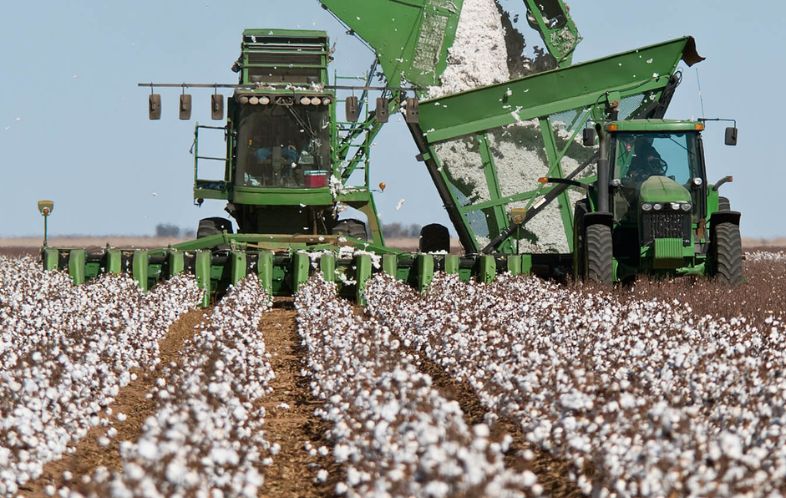
Top Cotton-Producing Countries in the World: Which Has the Highest Quality?
Not all cotton delivers the same textile results. Before becoming yarn, fabric, or garments, product quality is already influenced by the characteristics of the cotton fibers from the very start. Fiber length, strength, fineness, and uniformity can affect the spinning process as well as the characteristics of the resulting yarn.
Therefore, when discussing the best cotton in the world, we need to look not only at which country produces cotton in large quantities, but also at the quality of the cotton fibers and their suitability for the needs of the textile industry.
Top Cotton-Producing Countries in the World
There is no single country that produces "the best" cotton in absolute terms. Cotton quality is evaluated based on fiber characteristics and its suitability for specific product requirements. However, several countries play a crucial role in global cotton production and trade for the 2025/26 season.
Brazil
Brazil has now become the world's largest cotton exporter, surpassing the United States for three consecutive seasons. According to the latest USDA report (July 2026), Brazil's export projection was raised by approximately 300,000 bales from previous estimates, despite Brazil's production being revised downward due to smaller-than-expected harvest forecasts. In the May 2026 report, Brazil's exports for the 2025/26 season were projected to reach 14.7 million bales.
The scale of production and high export volume make Brazilian cotton one of the main sources of raw materials for the textile industry in various countries, including for spinning into cotton yarn.
United States
The United States remains one of the world's primary cotton producers and exporters, although its position as the top exporter has now been replaced by Brazil. The USDA projects US cotton exports at around 12 million bales for the 2025/26 season, with most of the demand driven by export markets such as Vietnam, Pakistan, and China.
The average US farm price for the 2025/26 season was revised to 62.5 cents per pound in the July 2026 report, slightly lower than projections in previous months due to global market dynamics.
The availability of US cotton in global trade makes it widely used as a raw material in the textile industry, including for spinning into cotton yarn.
Australia
Australia deserves a place in discussions about high-quality cotton and global trade, even though it remains the world's third-largest exporter after Brazil and the United States. Latest data (February 2026) projects Australian exports to rise by around 300,000 bales to 5.5 million bales for the 2025/26 season, although still below the record shipments of the 2022/23 season.
Most Australian cotton is marketed to countries with major spinning industries, including China and India. This makes Australian cotton highly relevant as a raw material for international textile needs.
Read also: Global Cotton Yarn Market 2026: Market Value, Trends, and Opportunities for the Textile Industry
China
China remains the world's largest cotton producer for the 2025/26 season. According to USDA data, China's production rose by approximately 3.8 million bales (12%) compared to the previous season, reaching 35.8 million bales, supported by a 5% expansion in harvested area and record-high yield improvements.
China's position as a major hub for the global textile industry means the cotton available in its market heavily supports the needs of large-scale spinning industries before being further processed into yarn and various textile products. China is also recorded as a major importer, with import projections revised upward by around 600,000 bales in the May 2026 report due to higher domestic consumption and import data.
India
India is one of the world's largest cotton producers while also possessing an immense textile industry. Domestic cotton is widely used to fulfill spinning and textile manufacturing needs, while international trade also forms a part of its supply chain. Latest data indicates that India's imports from the global market actually increased in the 2025/26 season, aligning with the growing demand of its domestic spinning industry.
The massive scale of India's spinning industry makes cotton quality play a crucial role in producing yarn for various textile applications.
Why is Cotton Quality Important for the Textile Industry?
Fiber characteristics affect yarn quality
In the spinning process, cotton characteristics such as fiber length, strength, fineness, and uniformity can directly influence the spinning process as well as the properties of the resulting yarn. Choosing the right raw material helps produce yarn with quality and consistency tailored to production requirements.
Quality yarn supports textile outcomes
Cotton quality does not end at the fiber stage. When processed into yarn, the quality of raw materials contributes directly to the final product's characteristics, including fabric strength, comfort, appearance, and consistency.
That is why cotton selection should be aligned with the intended textile application, rather than based solely on country of origin or price. The USDA itself utilizes raw-fiber equivalent data to monitor how fibers are utilized across various textile products, including yarn, thread, fabric, apparel, and home furnishings.
High-Quality Cotton from Various Countries Enters the Global Supply Chain
High-quality cotton is not always processed in the country where it is grown. Cotton can be exported as raw fiber or bales and subsequently processed into yarn and fabric in another country.
This demonstrates that the global textile industry is highly dependent on cross-border cotton trade. Based on the latest USDA data, world cotton production for the 2025/26 season is projected to reach 121.9 million bales, up 2% from the previous season and the highest since 2012/13, while global consumption (mill use) is estimated at around 118.6–120.0 million bales. Global ending stocks for this season are projected at around 75.7 million bales, with China, India, and Pakistan remaining the main contributors to cotton consumption by the global spinning industry.
Consequently, the quality of cotton from producing countries serves as a vital factor in determining the quality of raw materials used by textile manufacturers across the globe.