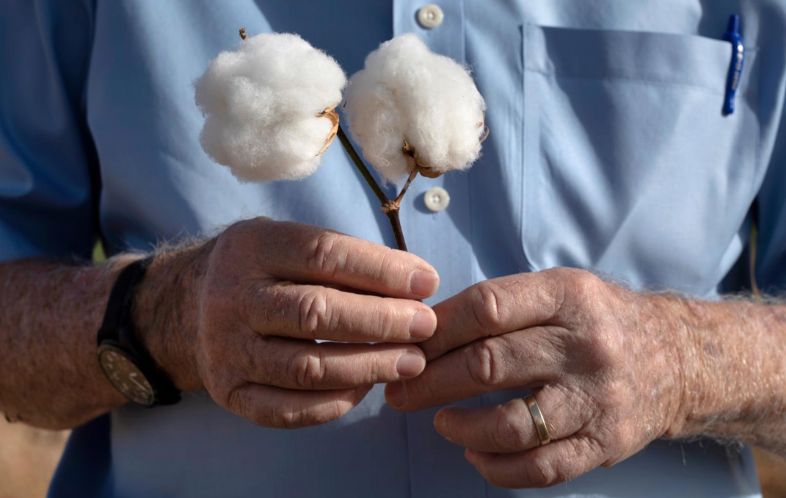
U.S. Cotton in the Textile Industry: Consistency, Quality, and Sustainability
In the textile industry, raw material selection is a crucial factor that determines process consistency and yarn quality. U.S. Cotton has become a widely used choice in the global textile industry, including spinning companies and textile manufacturers in countries such as Japan, South Korea, China, India, and across Europe. Consistent fiber characteristics, a measurable quality control system, and supply chain traceability support make U.S. Cotton a trusted raw material for yarn production.
For the spinning industry, cotton quality is not just about the country of origin, but also about how fiber characteristics can be consistently ensured and controlled. So, what makes U.S. Cotton a preferred choice for yarn production?
What Is U.S. Cotton?
U.S. Cotton refers to cotton grown and produced in the United States. It is globally recognized for its consistent fiber quality and performance, supported by low contamination levels and modern production methods.
How is the quality of U.S. Cotton measured?
Cotton quality is not evaluated visually alone. The USDA Agricultural Marketing Service conducts cotton classification by testing various fiber characteristics, including fiber length, length uniformity, fiber strength, micronaire, color, and trash content.
This information provides a more objective overview of each bale's condition, helping the spinning industry select and manage raw materials according to their production needs.
U.S. Cotton Characteristics for Yarn Production
Fiber length and length uniformity
Fiber length indicates the length of the fibers, while length uniformity describes how uniform that length is. Both are essential in the spinning process because fiber characteristics affect the yarn formation process and the consistency of the final product.
Fiber strength
Fiber strength shows the ability of the fiber to withstand force before breaking. This parameter is a key consideration when determining the suitability of cotton for specific yarn production needs.
Micronaire
Micronaire relates to the combination of fiber fineness and maturity. The micronaire value serves as an important parameter in cotton classification because it provides information regarding the processing characteristics of the fiber.
Read also: BCI vs US Cotton Trust Protocol: What Is the Difference and Which Is Right for the Textile Industry?
Why Does the Industry Choose U.S. Cotton?
Raw material consistency
In the spinning industry, raw material consistency is vital. Measurable fiber characteristic data helps spinners understand raw materials and make more precise process adjustments.
Measurable quality control
The classification system provides detailed data on fiber characteristics, allowing cotton selection to be executed based on required specifications rather than origin alone.
Technology & traceability
U.S. Cotton is also backed by a traceability system that makes the cotton's journey through the supply chain increasingly transparent. This is becoming even more relevant as today's textile industry looks beyond product quality to focus on the origin and processes behind raw materials.
Why Was the U.S. Cotton Trust Protocol Established?
Growing attention to sustainability has led brands, retailers, and consumers to demand clearer information about how cotton is produced. In response, the U.S. Cotton industry developed the U.S. Cotton Trust Protocol, which officially launched in 2020. This program was created to prove, measure, and verify more responsible cotton production practices through verifiable data.
Not just a label, but a verification system
The Trust Protocol is a farm-level sustainability program as well as a traceability platform for U.S. Cotton. It uses third-party verified data to monitor indicators such as land use, soil health, water management, soil erosion, greenhouse gas emissions, and energy efficiency.
As a result, the Trust Protocol helps provide stronger assurance to supply chains looking to use U.S. Cotton accompanied by more measurable sustainability and traceability information.
Danar Mas Group Uses U.S. Cotton
For us, raw material selection is an essential part of maintaining process consistency and product quality. Danar Mas Group incorporates U.S. Cotton into its yarn production, considering its fiber characteristics and consistency for spinning needs.
The use of U.S. Cotton is part of Danar Mas Group's approach to delivering high-quality yarn for the textile industry, supported by measurable production processes and quality control.
Ultimately, yarn quality begins long before the fiber enters the spinning machine. Choosing cotton with appropriate characteristics, ensuring raw material consistency, and maintaining supply chain transparency are essential steps in creating reliable textile products.
If you require textile products tailored to specific raw material specifications and fiber characteristics matching your production needs, please contact the Danar Mas Group team to discuss the right product options.