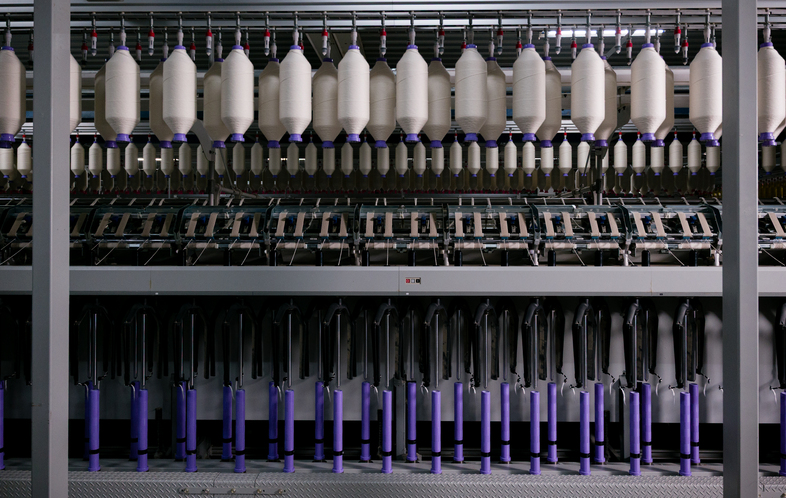
Understanding Cotton Yarn Spinning Process: Complete Guide from Blowing to Winding
Not everyone realizes that cotton yarn used to produce fabrics, garments, and premium textile products goes through a long and detailed manufacturing process. Before becoming ready-to-use cone yarn, cotton fibers must pass through a series of spinning stages known as the cotton yarn spinning process. In the textile industry, yarn quality is highly influenced by each spinning stage. From fiber cleaning and alignment to twist formation, every step plays an important role in producing yarn that is strong, smooth, and uniform.
So, how does the cotton spinning process work?
What Is Cotton Yarn Spinning Process?
Cotton yarn spinning is the process of converting cotton fibers into production-ready yarn through several mechanical stages. The goal is to produce yarn with specific characteristics suitable for weaving or knitting applications.
For combed cotton yarn production, the commonly used spinning flow is:
Blowing → Carding → Superlap → Comber → Drawing → Roving → Ring Frame → Winding
Each stage has a different function in improving fiber quality until it becomes final yarn.
Stages of Cotton Yarn Spinning Process in Textile Industry
1. Blowing (Fiber Opening and Cleaning Stage)
The first stage is blowing, where cotton bales are opened and cleaned from coarse impurities such as dust, leaves, and seed residues.
At this stage, compact cotton fibers are loosened to make them easier to process in the next stage. In addition to cleaning, blowing also helps mix fibers to create more homogeneous material quality.
This process serves as the foundation of yarn quality, as cleaner raw materials directly affect the final spinning result.
2. Carding (The Heart of Spinning Process)
After blowing, cotton enters the carding stage. This process separates fibers, removes finer impurities, and starts aligning fibers in a more parallel direction.
The output of carding is called card sliver, a more organized fiber strand ready for further processing.
Carding is crucial because it improves fiber cleanliness while reducing neps that may lower yarn quality.
3. Superlap (Preparation Before Comber)
In premium cotton spinning, material does not go directly from carding to drawing. Instead, it first goes through the superlap process. Superlap combines several slivers into lap form with a more stable structure for feeding into the comber machine.
This stage ensures a more consistent and optimal material supply to the comber.
4. Comber (Producing Premium Cotton Yarn)
The comber stage is an essential process in producing combed cotton yarn. During this process, short fibers, neps, and remaining impurities are removed so that only better-quality fibers continue to the next stage.
As a result, the yarn produced has characteristics such as:
- smoother texture
- stronger durability
- better uniformity
This is why combed cotton yarn is widely used for premium textile products such as high-quality apparel, baby wear, and fine fabrics.
Read also: The Secret Behind High-Quality Fabrics: The Role of Cotton Quality in Textile Production
5. Drawing (Sliver Leveling and Stabilization)
After combing, the material enters the drawing stage. Several slivers are combined and drafted to improve evenness, fiber alignment, and material homogeneity.
The output is a more stable sliver before entering the roving formation process.
6. Roving (Preparation Before Final Yarn Formation)
At the roving stage, sliver is drawn into a smaller size and given slight twist. Its purpose is to provide preliminary strength so the material can be processed in ring frame without breaking easily.
Roving can be considered as the bridge between drawing and final spinning.
7. Ring Frame (Final Yarn Formation)
The ring frame process is the core of spinning. At this stage, roving is drafted according to the required yarn count and given full twist to form final yarn.
Ring frame significantly determines:
- yarn strength
- yarn thickness or count
- yarn uniformity
The yarn produced from this stage is then ready for final processing.
8. Winding (Final Stage Before Yarn Usage)
The last stage is winding, where yarn is transferred into larger cones while undergoing yarn cleaning. Defects such as thick places, thin places, and neps are removed during this stage, making the cone yarn more suitable for weaving or knitting.
After winding, cotton yarn is ready to proceed to fabric production.
Find the Right Textile Solutions with Danar Mas Group
Understanding the cotton yarn spinning process helps you see how yarn quality is built from the earliest production stages. From blowing to winding, every process plays an important role in producing yarn with optimal performance.
If you are looking for the best textile products for industrial, garment, or fashion needs, the team at Danar Mas Group is ready to help you find the right solution.
Contact Danar Mas Group for more information about our textile products and services.