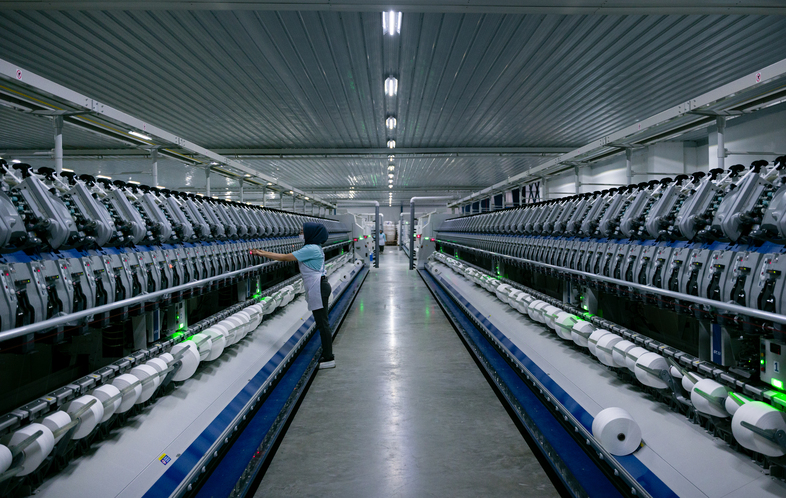
Why Is MVS Spinning Widely Used? Understanding Its Process and Advantages
Technological advancements in the textile industry are not only reflected in finished products, but also in yarn manufacturing processes. One innovation that has gained significant attention is MVS Spinning, a modern spinning technology known for its efficiency and ability to produce high-quality yarn. Compared to conventional spinning methods, this technology offers several advantages, including lower hairiness, more consistent yarn quality, and improved production efficiency.
So, how does MVS Spinning work, and why is it becoming increasingly popular in the modern textile industry?
What Is MVS Spinning?
Understanding Murata Vortex Spinning (MVS)
MVS Spinning stands for Murata Vortex Spinning, a yarn spinning technology based on high-speed air flow developed by Murata Machinery. Unlike traditional spinning systems that rely on mechanical twisting, MVS uses vortex air technology to form yarn.
In this process, the core fibers remain straight while the outer fibers wrap around the core, creating a cleaner and more compact yarn structure.
Why Is This Technology Becoming More Popular?
Compared to conventional spinning methods, Murata Vortex Spinning (MVS) is known for its high production speed, low yarn hairiness, and more stable yarn quality. These advantages make many textile manufacturers consider MVS technology to improve production efficiency and fabric performance.
How Does MVS Spinning Work?
1. Fiber Drafting
The process begins when sliver or fibers enter the drafting zone, where they are stretched and aligned. This stage is essential to ensure more consistent fiber orientation before spinning.
2. Entering the Vortex Nozzle
After drafting, the fibers pass through a specialized nozzle that generates high-pressure airflow. This airflow creates a vortex that controls the movement and arrangement of the fibers.
3. Yarn Formation
The core fibers remain straight in the center, while some outer fibers wrap around the core. The result is a distinctive core-sheath yarn structure commonly found in MVS yarns. This structure helps reduce yarn hairiness and improves fabric appearance.
Comparison Between MVS Spinning and Other Spinning Methods
| Aspect | MVS Spinning | Ring Spinning | Open-End Spinning |
|---|---|---|---|
| Technology | Uses vortex airflow to form yarn | Uses mechanical twisting with spindle and ring | Uses high-speed rotor system |
| Production Speed | Very high | Relatively slower | High |
| Hairiness | Low, cleaner yarn surface | Generally higher | Low to medium |
| Yarn Structure | Straight core with wrapped outer fibers | Compact and natural structure | Bulkier yarn structure |
| Hand Feel | Crisp and stable | Softer and more natural | Slightly rougher |
| Anti-Pilling Performance | Better | Standard | Fairly good |
| Quality Consistency | High | High, depending on process control | Stable for mass production |
| Suitable Applications | Sportswear, t-shirts, home textile, activewear | Premium apparel, woven fabric, high-quality garments | Denim, towels, basic textile, mass production |
| Production Efficiency | Highly efficient for high output | Less efficient for large-scale production | Efficient and economical |
Overall, MVS Spinning is often preferred by manufacturers seeking a balance between production speed, consistent yarn quality, and improved fabric performance.
Meanwhile, Ring Spinning remains widely used for premium textile products with a softer and more natural hand feel, while Open-End Spinning is more suitable for cost-efficient mass production.
Applications of MVS Spinning in the Textile Industry
Apparel and Fashion
MVS Spinning is commonly used for:
- Basic t-shirts
- Innerwear
- Sportswear
- Casual wear
Home Textile
In addition to apparel, this technology is also widely applied in:
- Bedsheets
- Towels
- Lightweight woven fabrics
The clean and durable yarn characteristics make MVS suitable for various modern textile applications.
MVS Spinning has become one of the most important innovations in the textile industry because it combines high production speed, consistent yarn quality, and improved fabric performance. With advantages such as low hairiness, anti-pilling properties, and high efficiency, it is no surprise that this technology is increasingly adopted by global textile manufacturers.
For high-quality textile products tailored to your business needs, please contact Danar Mas Group for more information.