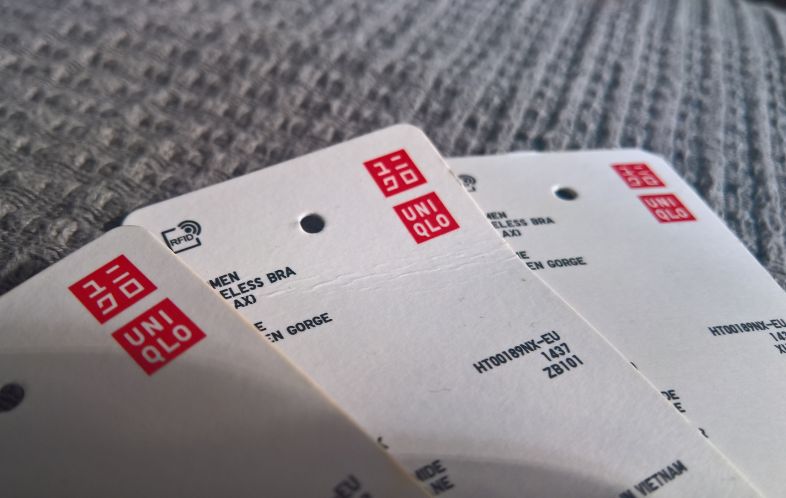
Hang Tag in Textile Products: A Real Role in Enhancing Trust and Brand Value
Have you ever seen a textile product with great quality, but it felt "unconvincing" at first glance? In many cases, the problem isn't the product itself, but rather the lack of communication elements like a hang tag. For business owners, a hang tag is more than just an extra label. It is the first point of contact between the product and potential buyers.
This is where perceptions of quality, professionalism, and brand credibility begin to take shape.
What is a Hang Tag and Why is it Important?
A hang tag is a label usually attached to a product using a string, containing essential information as well as branding elements. However, in industry practice, its function is far more strategic.
More than just product information
Hang tags typically include:
Material composition
Care instructions
Size & product codes
Brand identity
However, for B2B purposes, hang tags also function as:
A tool to communicate product value (premium, sustainable, etc.)
Standardized information for global buyers
Support for export compliance
According to global industry practices recommended by the International Organization for Standardization (ISO), textile labeling must be clear, accurate, and easy to understand—especially for international markets.
The Strategic Role of Hang Tags in the Textile Supply Chain
1. Increasing Buyer Trust
In B2B transactions, buyers often look not only at physical samples but also at how the product is "presented." An informative and professional hang tag signals that your brand is serious and ready to scale.
2. Supporting Branding & Positioning
Hang tags are an often undervalued branding medium. The design, material, and finishing can reflect your positioning:
Kraft paper leans toward eco-friendly
Embossing / foil feels more premium
Minimalist suits modern brands
3. Simplifying Distribution & Retail Handling
For distributors or retailers, hang tags help with:
Faster product identification
Minimizing display errors
Speeding up inventory processes
4. Supporting Regulatory Compliance
Some countries have strict regulations regarding textile product information. Hang tags can complement the main label to ensure information remains visible and compliant.
Read also: Woven vs Non-Woven: Differences, Examples, and How to Choose the Right One for Your Business
Common Mistakes in Using Hang Tags
Attractive Design, Minimal Information Many brands focus too much on aesthetics but forget crucial details like material composition or care instructions.
Inconsistency with Brand Identity A hang tag that "clashes" with the brand identity can lower the perception of professionalism.
Ignoring Material Quality Hang tags that are easily damaged or look cheap can reduce the perceived value, even if the product itself is of high quality.
Hang Tags as a Silent Sales Tool
In a B2B context, a hang tag can act as a silent salesman. Imagine your buyer is comparing several suppliers. The products might look similar, but a hang tag that:
Explains material advantages
Conveys values (e.g., sustainability/durability)
Is organized neatly and professionally
In some cases, hang tags are also used for:
QR codes linking to digital catalogs
Brief brand storytelling
Highlighting certifications (e.g., OEKO-TEX, GRS)
This is no longer just a label; it is a part of the product communication strategy.
Optimizing hang tags on textile products is not just about aesthetics—it is about how you communicate quality, build trust, and strengthen your positioning in the eyes of the buyer.
In an increasingly competitive market, these small details are often the true differentiators. Now, try to evaluate: "Is your product's hang tag truly 'working' for you, or is it just an afterthought?"
If you have ever found a hang tag that instantly made a product feel more premium or convincing, it is worth analyzing: what made it stand out?