4 Eco-Friendly Technologies Transforming Modern Textile Production
The textile industry is known as one of the largest manufacturing sectors in the world. However, behind its growth, it also faces significant challenges related to water and energy consumption, as well as chemical waste generated during production processes. In fact, global textile production is estimated to contribute around 10% of global carbon emissions and more than 20% of industrial water pollution.
The good news is that various technological innovations are now transforming how the textile industry operates. Eco-friendly technologies in modern textile production enable companies to reduce water usage, energy consumption, and chemical waste—without compromising product quality.
Here are four eco-friendly technologies that are increasingly being adopted in the modern textile industry.
1. Waterless Dyeing
Supercritical CO₂ Dyeing Technology
One of the most revolutionary innovations in modern textile production is waterless dyeing, a process that dyes fabrics without using water as the primary medium.
In this method, high-pressure carbon dioxide (CO₂) is used to carry dyes into the fabric fibers. Once the process is complete, the CO₂ can be recycled and reused within a closed-loop system.
Benefits of Waterless Dyeing for the Textile Industry
This technology offers several advantages for sustainable textile production, including:
- Eliminating water usage in the dyeing process
- Reducing wastewater from textile manufacturing
- Saving energy and production time
- Producing more consistent and long-lasting colors
Several global brands have already adopted this technology to support more environmentally friendly textile production practices.
2. Digital Textile Printing
A More Efficient and Low-Waste Fabric Printing Process
Digital textile printing is an inkjet-based fabric printing technology that allows designs to be applied directly onto fabric surfaces with high precision. Compared to conventional methods such as rotary screen printing, this technology is significantly more efficient in terms of ink, water, and energy usage.
Digital dyeing technology can even reduce energy consumption by up to 85% while generating almost no wastewater during production.
Advantages of Digital Printing in Textile Production
Some of the key benefits of this technology include:
- Reduced use of water and chemicals
- Lower ink waste
- Supports on-demand production to prevent overproduction
- Enables more detailed and flexible design possibilities
With these advantages, digital printing has become one of the key technologies driving the shift toward eco-friendly textile production.
3. Solution Dyeing
Coloring Fibers at the Earliest Stage
Solution dyeing is a coloring technology applied at the initial stage of synthetic fiber production. Pigments are added directly to the raw material before the fibers are spun into yarn.
This approach makes the dyeing process more efficient, as the color is already embedded within the fibers from the beginning.
Positive Impact on Sustainable Production
Compared to conventional dyeing methods, solution dyeing offers significantly lower environmental impact, such as:
- Reducing water usage by up to 75%
- Decreasing chemical usage by up to 90%
- Lowering energy consumption and carbon emissions during production
Due to its efficiency, this technology is increasingly popular in the production of polyester fibers and modern synthetic textiles.
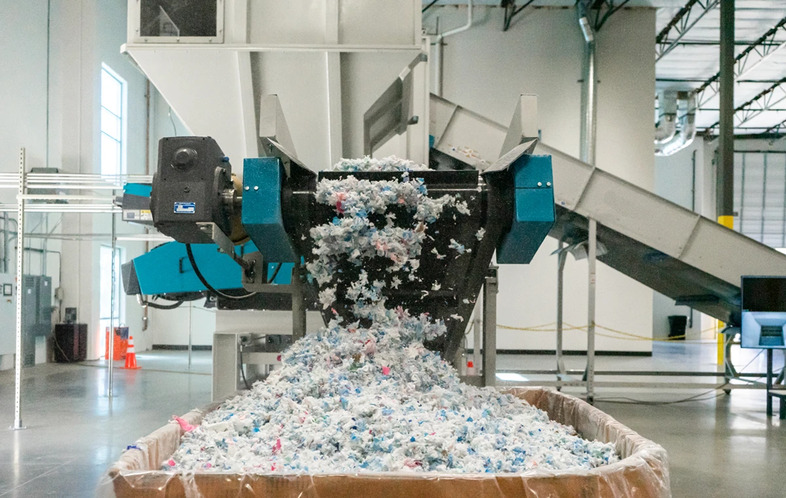
4. Textile Recycling Technology
Turning Textile Waste into New Materials
One of the biggest challenges in the textile industry is production waste and post-consumer garments. Textile recycling technology provides a solution by converting this waste into new fibers that can be reused in the production process.
This approach is part of the circular economy concept within the textile industry.
The Role of Technology in Recycling Systems
Modern technology now enables more efficient sorting and processing of textile fibers, including the use of scanning systems and artificial intelligence to automatically identify different types of textile materials.
With the growing adoption of recycling technologies, the textile industry can:
- Reduce textile waste sent to landfills
- Minimize the use of virgin raw materials
- Support more sustainable textile production systems
Eco-Friendly Technology as the Future of the Textile Industry
The development of eco-friendly technologies in modern textile production shows that the industry is moving toward more sustainable manufacturing systems.
Innovations such as waterless dyeing, digital textile printing, solution dyeing, and textile recycling are helping the textile industry reduce natural resource consumption while minimizing environmental impact.
For industry players, adopting these technologies not only improves operational efficiency but also strengthens competitiveness in a global market that increasingly demands sustainable textile products.
As innovation in the textile industry continues to evolve, do you think eco-friendly technologies will become the new standard in modern textile production?